What Is a Manifold?
High-dimensional datasets often live on a lower-dimensional surface — a manifold — that is crumpled up inside the ambient space. A classic toy example is the Swiss Roll: a 2-D sheet rolled into 3-D. Linear methods like PCA see only the 3-D spread and cannot recover the flat sheet underneath. Nonlinear techniques like Manifold Sculpting can.
What the Algorithm Preserves: δ and θ
Manifold Sculpting anchors its fidelity on two local geometric quantities measured for every point and each of its k-nearest neighbors:
δij — the Euclidean distance from point pi to its neighbor nij, and θij — the angle at nij between pi and the most-collinear neighbor mij.
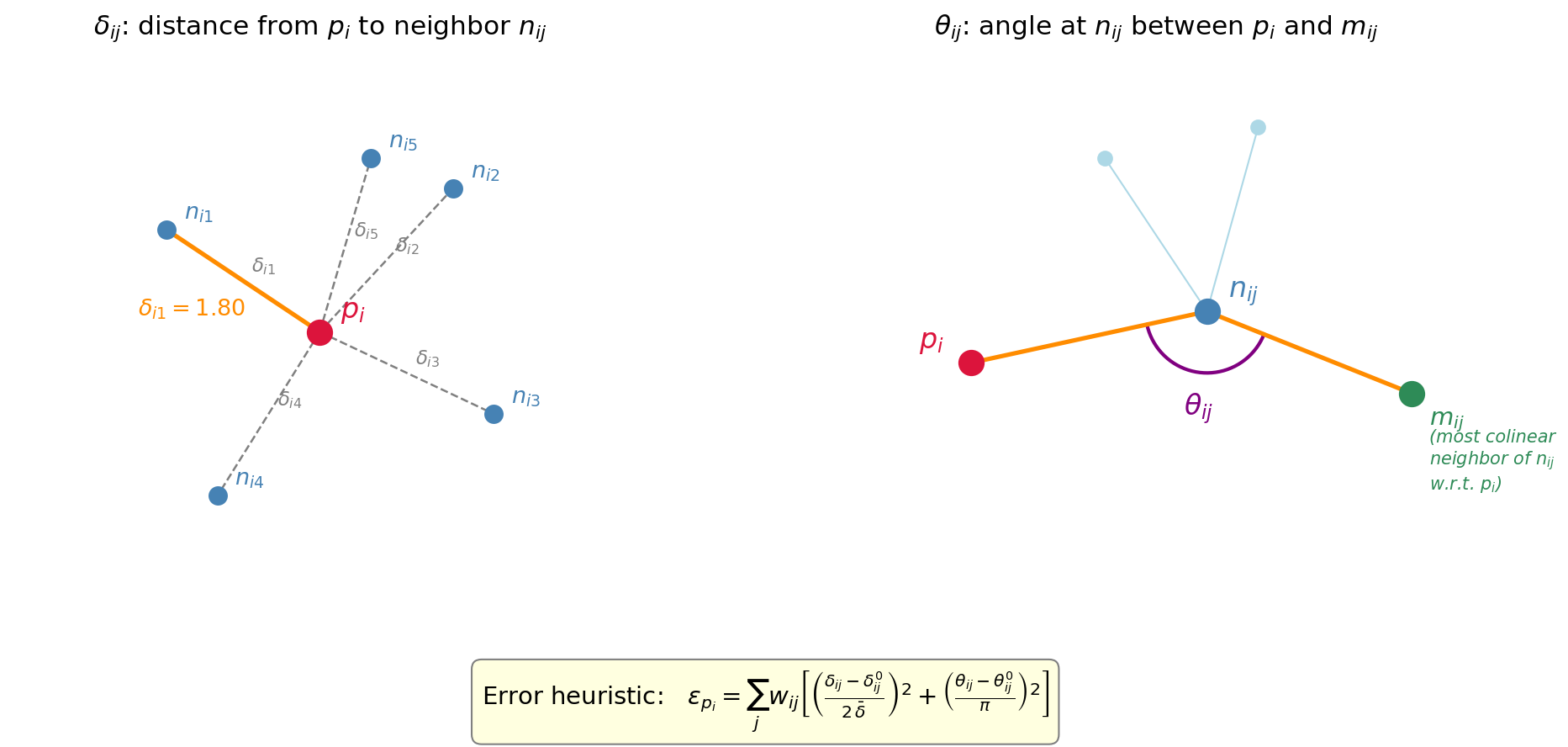
Together, these two quantities capture both the scale (how far apart are neighbors?) and the shape (what direction are they in?) of the local neighborhood. The algorithm's error heuristic penalizes deviations in both:
The Sculpting Process
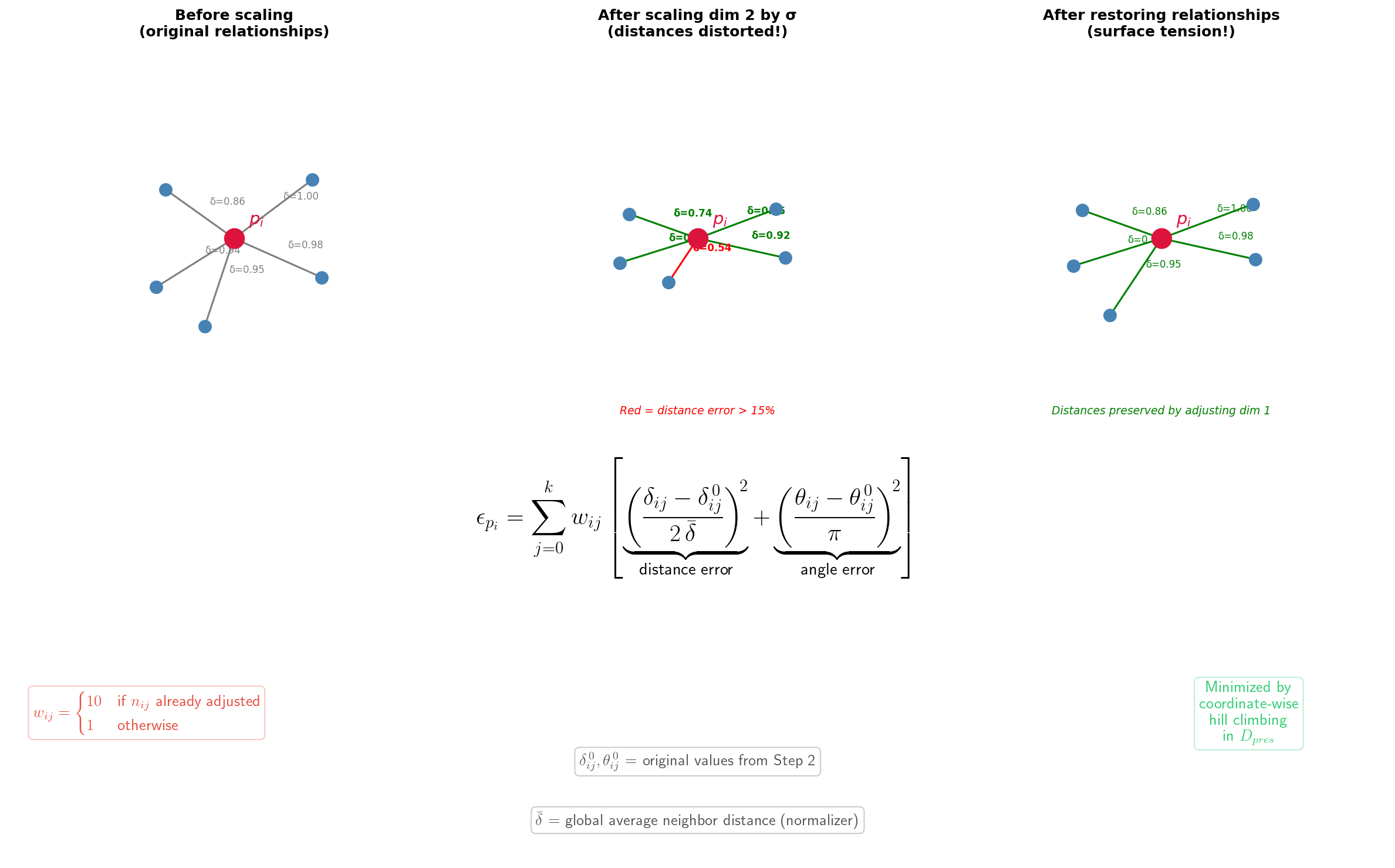
Sculpting proceeds iteratively. At each step, the dimensions targeted for removal are scaled down by a factor σ (e.g. 0.99), which distorts local neighborhoods. The algorithm then traverses every point via breadth-first search and nudges it to restore the original δ and θ values — like a surface under tension snapping back into shape.
After enough iterations the unwanted dimensions are effectively zero and can be dropped, yielding the final low-dimensional embedding.
How Does It Compare?
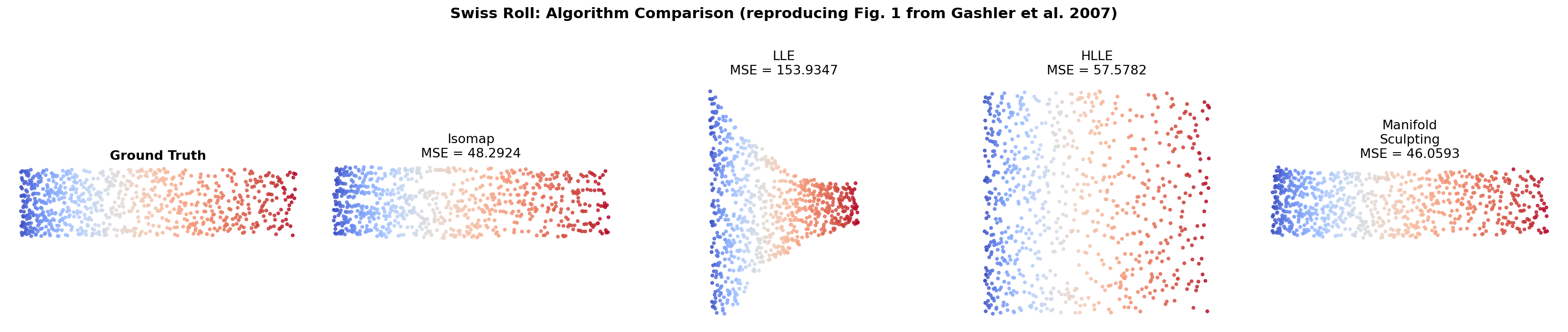
The chart below reproduces the Swiss Roll benchmark from the original paper. Each panel shows the 2-D embedding produced by a different algorithm, colored by the ground-truth parameter. A perfect result would recover the original rectangular color gradient with no folds or tears.
Beyond the Swiss Roll: S-Curve
To confirm the algorithm is not over-tuned to a single manifold, here it is applied to an S-Curve — a surface with non-uniform curvature. The sculpting process cleanly flattens it into 2-D while preserving local neighborhoods.
The Five Steps
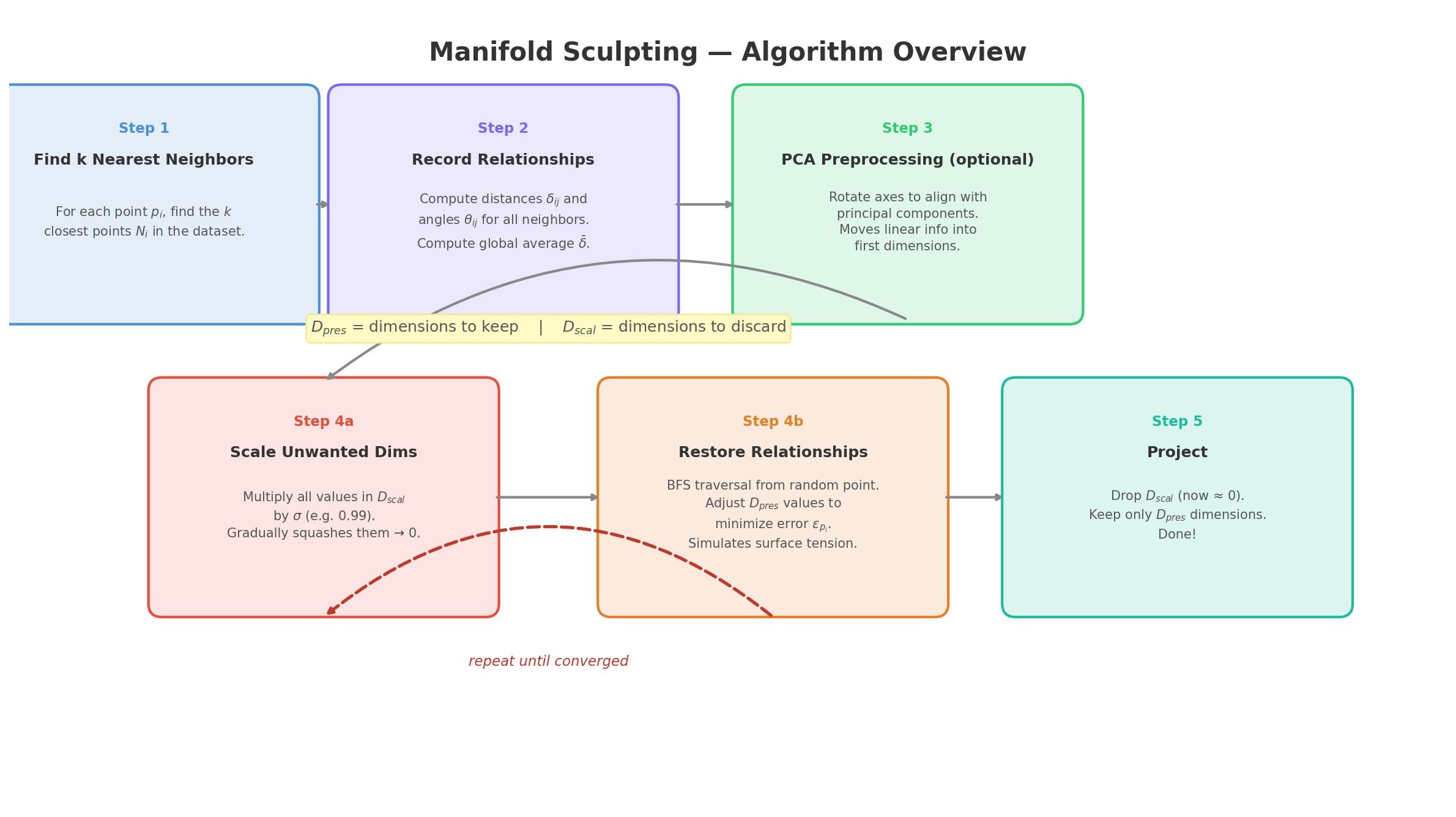
At a high level, Manifold Sculpting consists of five stages:
1. Compute k-nearest neighbors for every point.
2. Record initial δ and θ values; compute the global
mean distance δ̄.
3. (Optional) Pre-process with PCA so the first axes
carry the most variance.
4. Iterate: scale unwanted dimensions by σ, then restore
neighborhoods via BFS + hill climbing.
5. Drop near-zero dimensions to obtain the final
embedding.
The Error Heuristic
The restoration step (4b) minimizes a per-point error that balances distance preservation and angle preservation. The distance term is normalized by twice the global mean distance (2δ̄), while the angle term is normalized by π, putting both on a comparable scale.
A weighting factor wij = 10 is applied to neighbors that have already been adjusted earlier in the current BFS pass, preventing the wavefront from undoing its own work.
Why Manifold Sculpting?
Manifold Sculpting offers a compelling alternative to spectral methods like Isomap and LLE. Its strengths include:
Intuitive mechanism — iteratively shrink-and-restore is
easy to visualize and debug.
Dual preservation — maintaining both distances and angles
avoids local distortions.
No eigensolver — the algorithm uses only nearest-neighbor
queries and simple arithmetic.
Flexibility — the target dimensionality can be changed
without re-running the entire pipeline.