What fraction of tiles ends up on a loop?
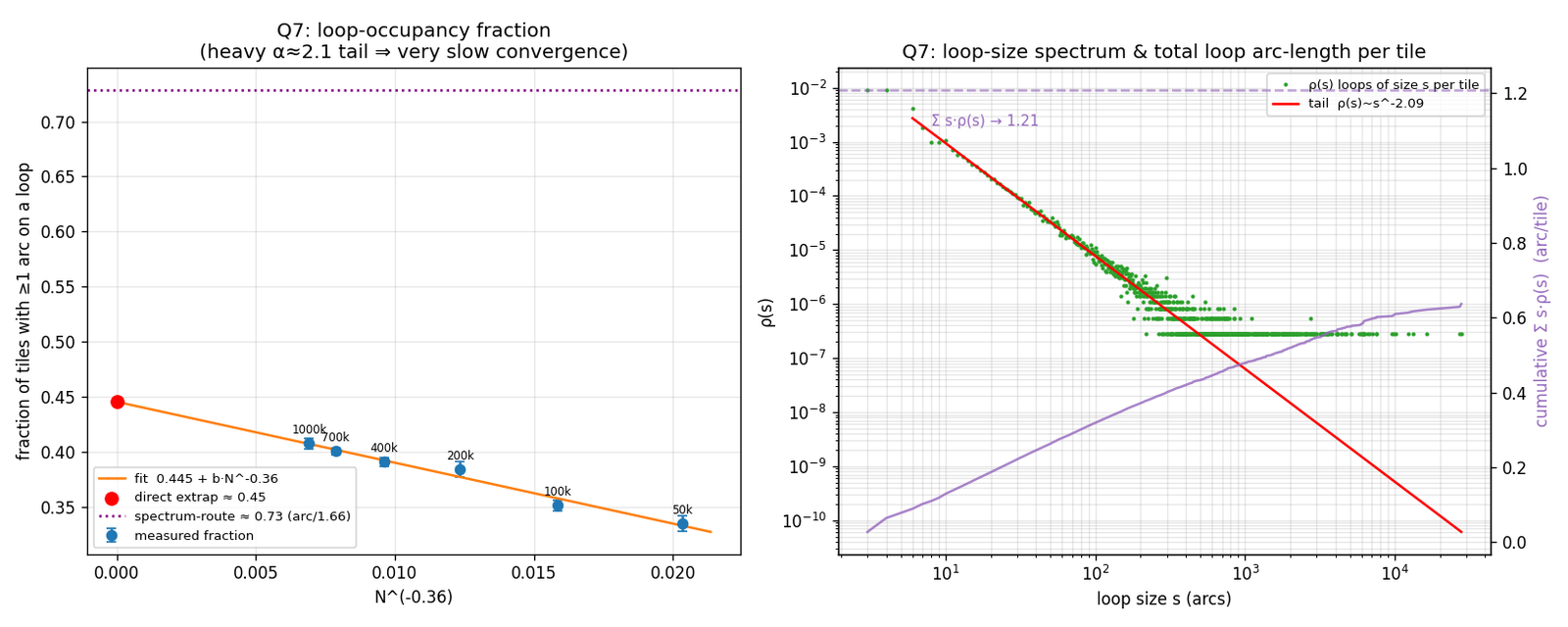
A finite constant — but a surprisingly subtle one. The fraction of tiles whose arc belongs to a closed loop is Σ s · ρ(s), summing loop-size × density over all sizes. From Q2 and Q5 we know ρ(s) ~ s−α with α ≈ 2.09. That exponent is just barely above 2 — the marginal value where the sum barely converges.
Sizes 3 and 4 alone account for roughly half the loop density (ρ(3) = ρ(4) = 1/108 exactly from Q10). The rest accumulates slowly from the heavy tail — one giant loop per patch contributes as much as dozens of small ones.
Why is α ≈ 2 marginal? The boundary-end picture
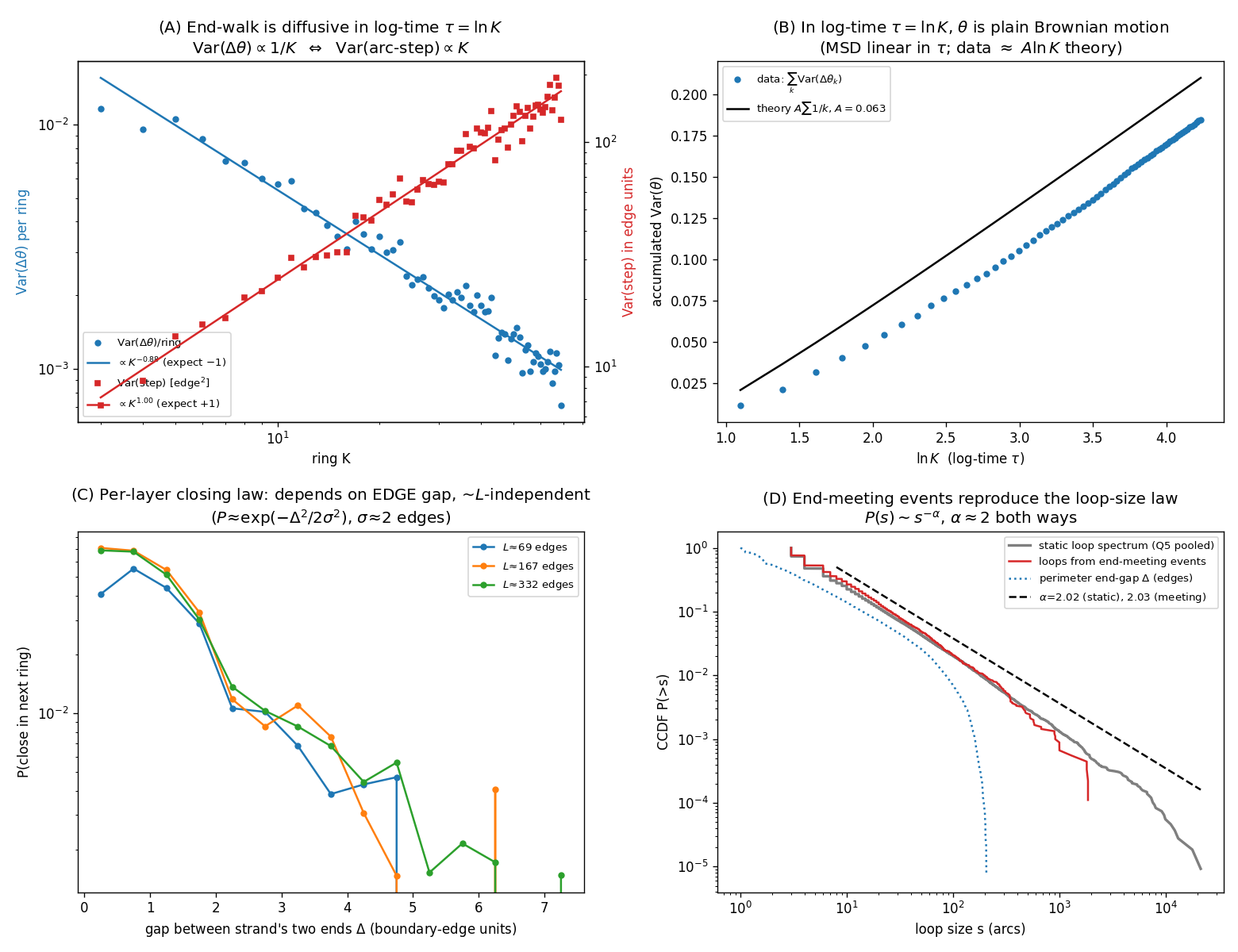
An open strand has exactly two ends, each sitting on a boundary edge of the growing patch. As each new ring is added, these ends can move — they random-walk on the perimeter as new tiles connect to them.
The key finding from Q11 is that this is Brownian motion in log-time τ = ln K (ring index K): the variance in an end's angular position grows linearly in τ, i.e. proportional to 1/K per ring. The single-ring step is heavy-tailed (kurtosis ~77!), but averaged over many steps the drift is diffusive in logarithmic time. Neighbouring ends on the perimeter co-move (correlation +0.55), but a strand's own two ends are nearly independent (correlation +0.06) — so the gap between them is a clean, slow random walk.
The interactive widget below lets you watch this in real time. Pick a strand (amber = end A, pink = end B), watch the two dots wander the boundary ring by ring, and observe how the gap Δ stays small even as the perimeter grows.