A rule that never makes a loop
The simplest imaginable spiral rule is to give every tile the same rotation r₀. Empirically the loop counter drops to zero — and it stays zero regardless of r₀ and regardless of patch size.
Why it works. With a fixed r₀, the "incoming edge → outgoing edge" map is a translation-invariant permutation of the six side types. That permutation consists of two 3-cycles, each with a nonzero net lattice drift (±2 cells per 3 steps). A strand that drifts by a fixed nonzero vector every 3 cells can never revisit a lattice edge — so it can never close. In any finite patch it simply exits through the boundary: loops = 0 and paths = B/2 exactly. Verified on a radius-200 patch (120,601 cells) and a spiral of N = 10⁵.
Greedy avoidance also never gets stuck. Even without committing to a fixed r₀ globally, a greedy policy — pick any loop-free rotation at each step — never runs out of choices. Blocking all six rotations requires the alternating edge-triple {0,2,4} (or {1,3,5}) to already be co-connected among the current cell's neighbours. But spiral order only ever exposes a contiguous arc of placed neighbours, so that triple never arises.
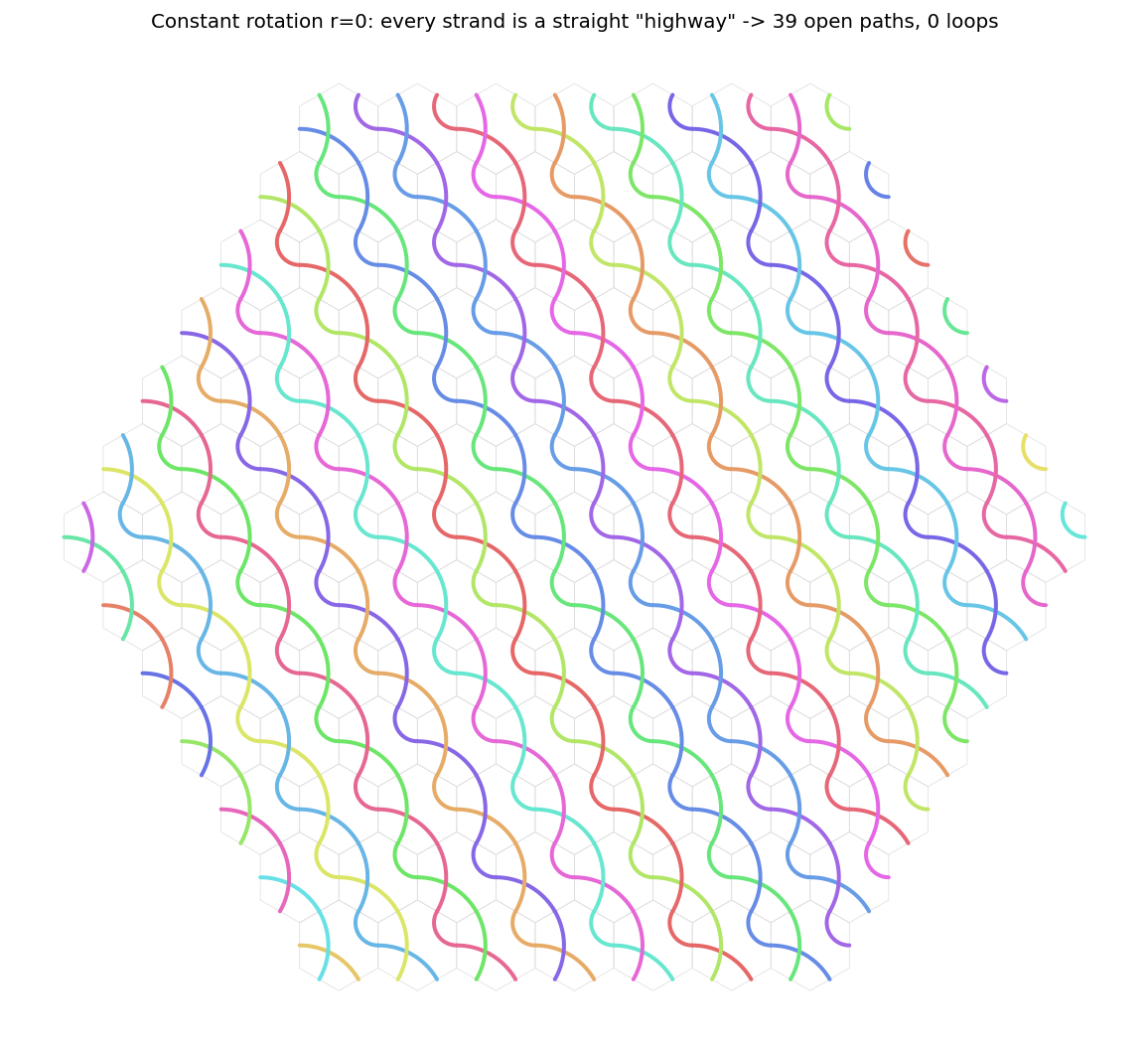
The slider above lets you try all six rotations. Notice that the strands snap between diagonal families — one family for each rotation — while the loop counter stays at zero every time.
The two-player misère game
Now make it competitive. Two players alternate placing spiral tiles, each choosing any rotation. You lose the instant your placement closes a loop (a fully loop-free board is a draw).
This is the adversarial strengthening of Q3. The proof comes down to two structural facts about the spiral:
- At most 4 placed neighbours. Every spiral cell, when it is placed, has at most four already-placed neighbours (those placed in earlier rings).
- Neighbours form a contiguous arc. Those placed neighbours always occupy a contiguous arc of the six sides — never the alternating pattern {0,2,4} or {1,3,5}.
Together these prevent the only geometric configurations where all six rotations would close a loop (the "alternating-triple killers"). Because such traps are geometrically impossible in spiral order, a safe rotation always exists — no matter how adversarially the opponent has played. There is no parity effect and no first- or second-player advantage.
The live safe-rotation count in the widget below (the green badge showing how many choices are safe at each step) never drops to zero — play as many games as you like. The "Auto (greedy)" mode confirms the theorem automatically, filling the entire board without closing a loop.
In the rotation picker, green-bordered tiles are safe placements; red-bordered tiles would close a loop and lose the game. The theorem guarantees at least one green option always exists — but choosing which green option, and trying to steer your opponent toward the reds, is the combinatorial texture of the game.