One loop per ~28 tiles. Forever.
Place tiles at random, one by one. Two counts evolve in concert:
exact — a boundary effect
c ≈ 0.03568 (emergent)
= 1 / c, asymptotically
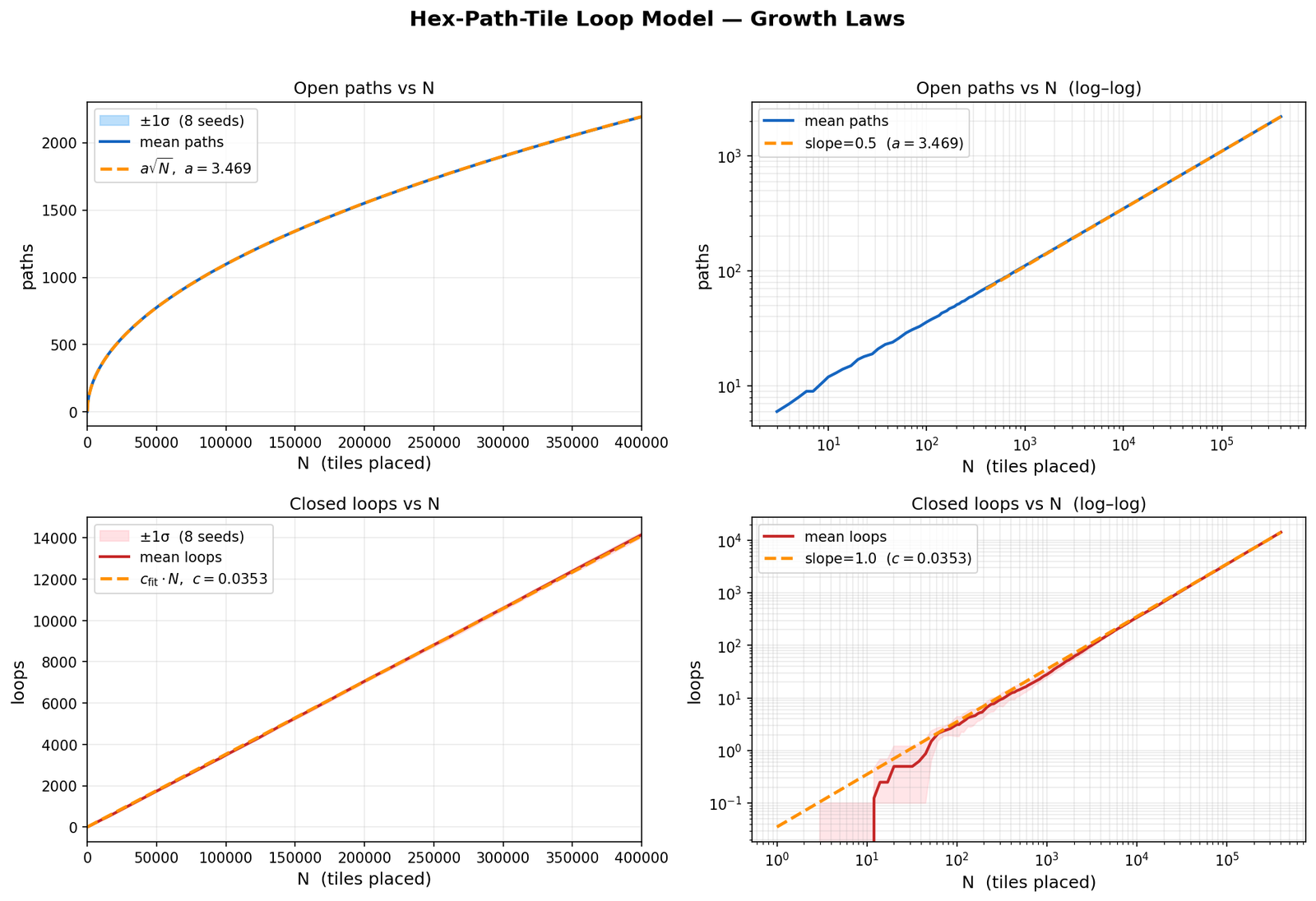
The path count is exactly determined by the boundary: every open path has two ends
on the outer boundary, so paths = B/2. For a hexagonal spiral of N tiles the
boundary length is B = 6(k+1) at ring k, giving
paths ≈ 2√3 · √N. No simulation needed — it is an Euler-characteristic identity.
The loop count is genuinely random. Simulation at N = 4×10⁵ (8 seeds) shows strict
linear growth with log-log slope 1.0 ± 0.001, confirming convergence of loops/N to
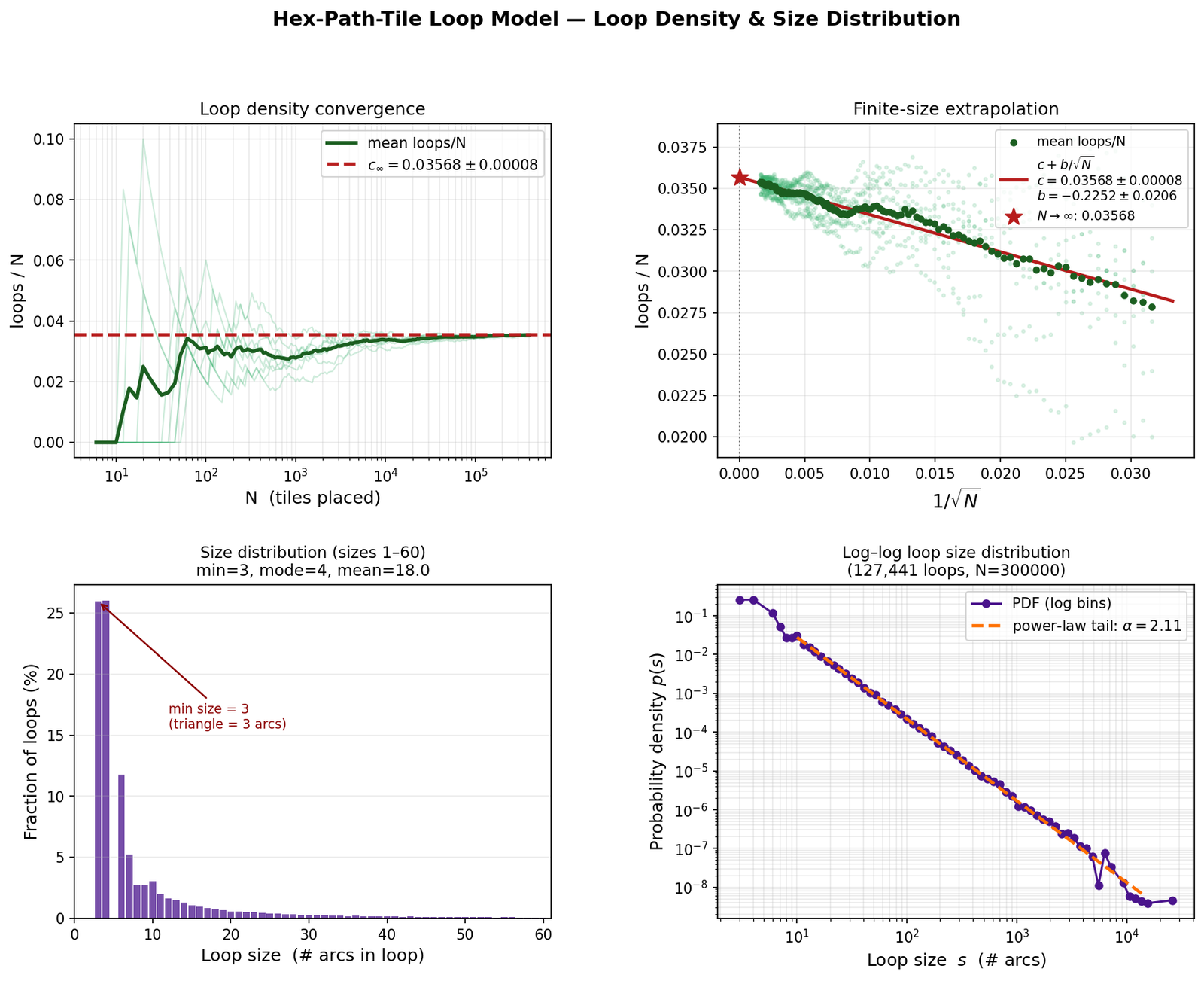
the constant c. The finite-size fit loops/N = c + b/√N with b ≈ −0.225 captures
the boundary suppression; extrapolating gives c = 0.035683 ± 0.000081.
A power law with a gap
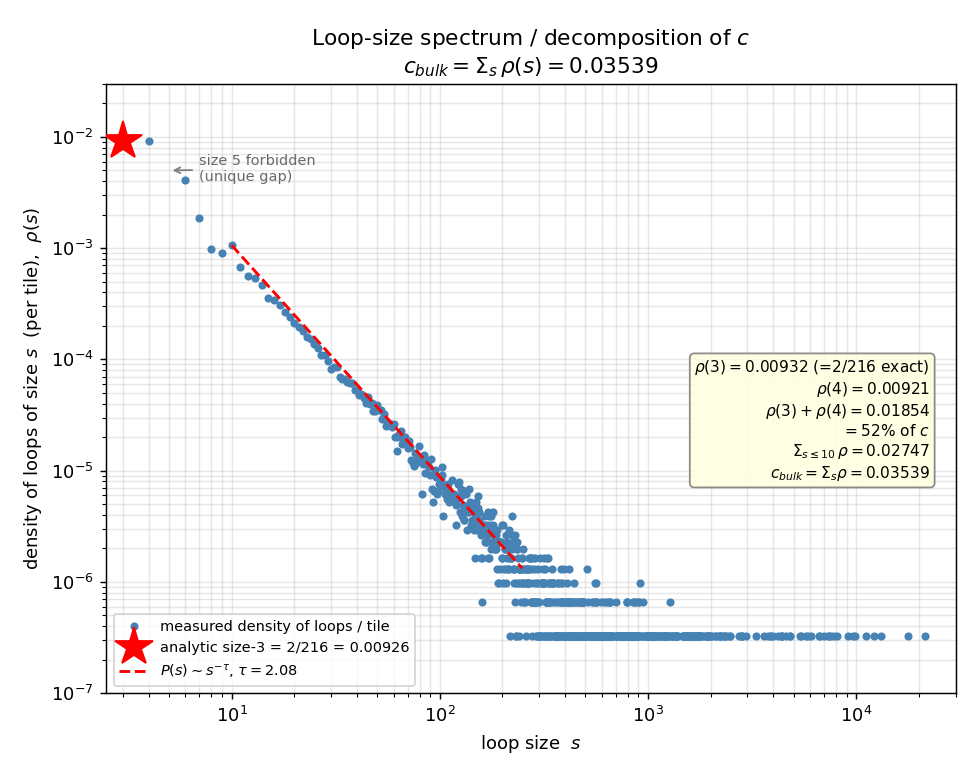
Decompose the density by loop size s: let ρ(s) = (loops of size s) / (total tiles). The spectrum has two striking features:
Power-law tail: for s ≥ 6, ρ(s) ∼ s−2.11. Because α < 3 the variance of loop sizes diverges — most loops are tiny but rare giants dominate total enclosed area (a 900-tile patch can contain one 81-arc monster alongside twenty size-3 specks).
Two size classes are exactly computable from the dual-lattice geometry (see §4 below). The rest of the constant c comes from summing the power-law tail:
Sizes 3 and 4 together give 1/54 ≈ 0.0185, about 52% of c. Size 5 is uniquely absent — the gap is visible in every simulation run and is a consequence of a geometric impossibility, proved in §3.
Why no loop has exactly 5 arcs
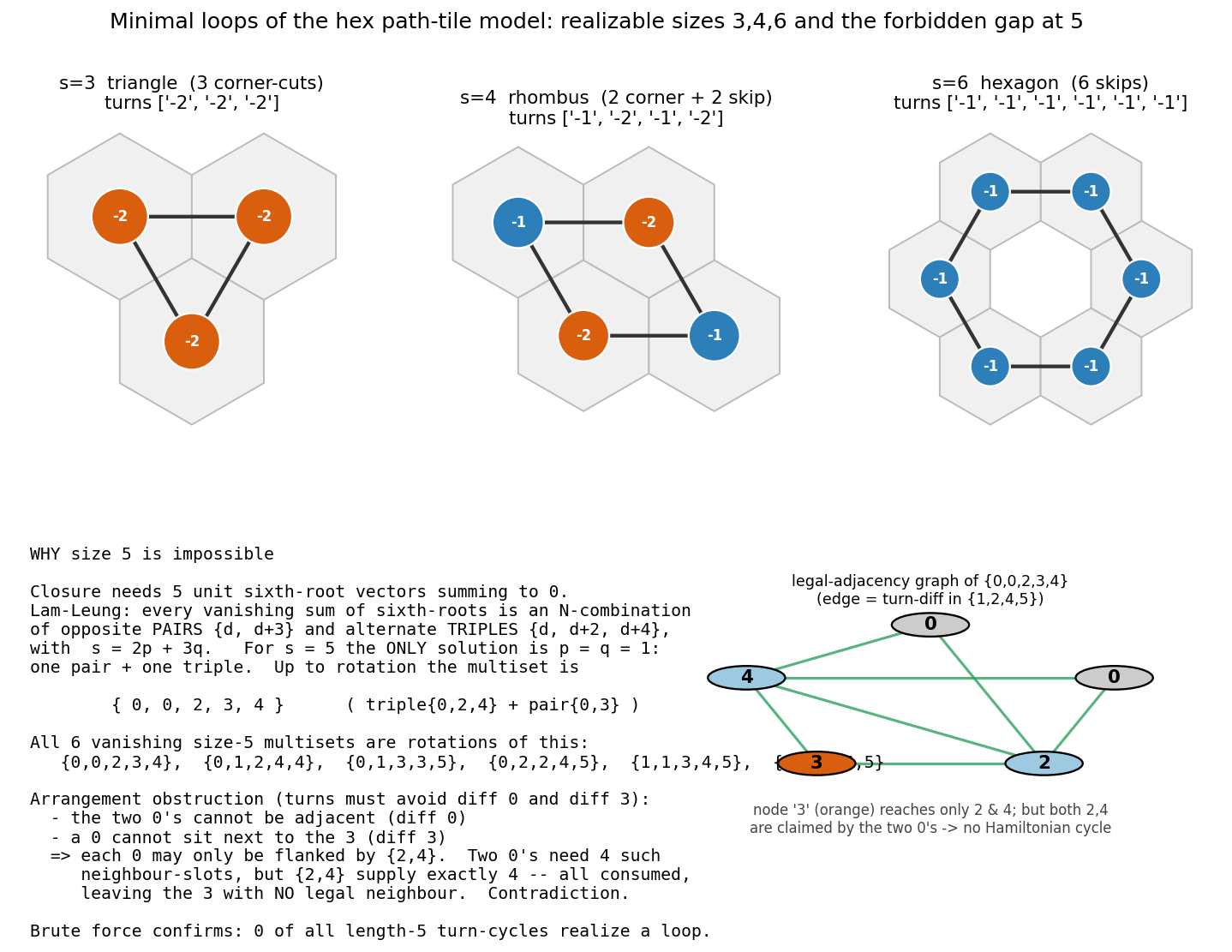
A loop of s arcs is a closed walk on the triangular lattice of hex cells: each step moves to an adjacent cell, and each arc turns the walk by ±60° (a skip) or ±120° (a corner-cut). Closure requires the step-vector sum to equal zero.
By the Lam–Leung theorem on vanishing sums of roots of unity, closure with exactly 5
sixth-roots of unity has a unique candidate multiset (up to rotation): {0, 0, 2, 3, 4}.
But no cyclic arrangement of this multiset satisfies the adjacency constraint — size 5 is impossible.
Try it yourself. The widget below lets you build walks step by step. Click turn buttons to add steps. Hit "Try all" to run an exhaustive search — you will find exactly zero closed walks of length 5, regardless of the starting direction.
Lam–Leung argument (sketch)
Any vanishing sum of 5 sixth-roots of unity must (by Lam–Leung, 2000) decompose as
one opposite pair (summing to 0) plus one alternating triple (summing to 0):
the unique multiset is {d, d+3, d, d+2, d+4} = {0,0,2,3,4} up to rotation.
The adjacency rule for consecutive steps is: two directions a, b may appear consecutively iff |a − b| mod 6 ∈ {1, 2, 4, 5} (i.e. not 0 = straight, not 3 = U-turn).
The two 0s must each be flanked by elements of {2, 4} (the only admissible neighbours of 0). Two 0s consume all 4 flank-slots of {2, 4}. This leaves direction 3 with no admissible neighbour in any cyclic arrangement. Contradiction — ρ(5) = 0 is a theorem.
Why ρ(3) = ρ(4) exactly
The equality ρ(3) = ρ(4) = 1/108 looks like a coincidence until you see the dual structure.
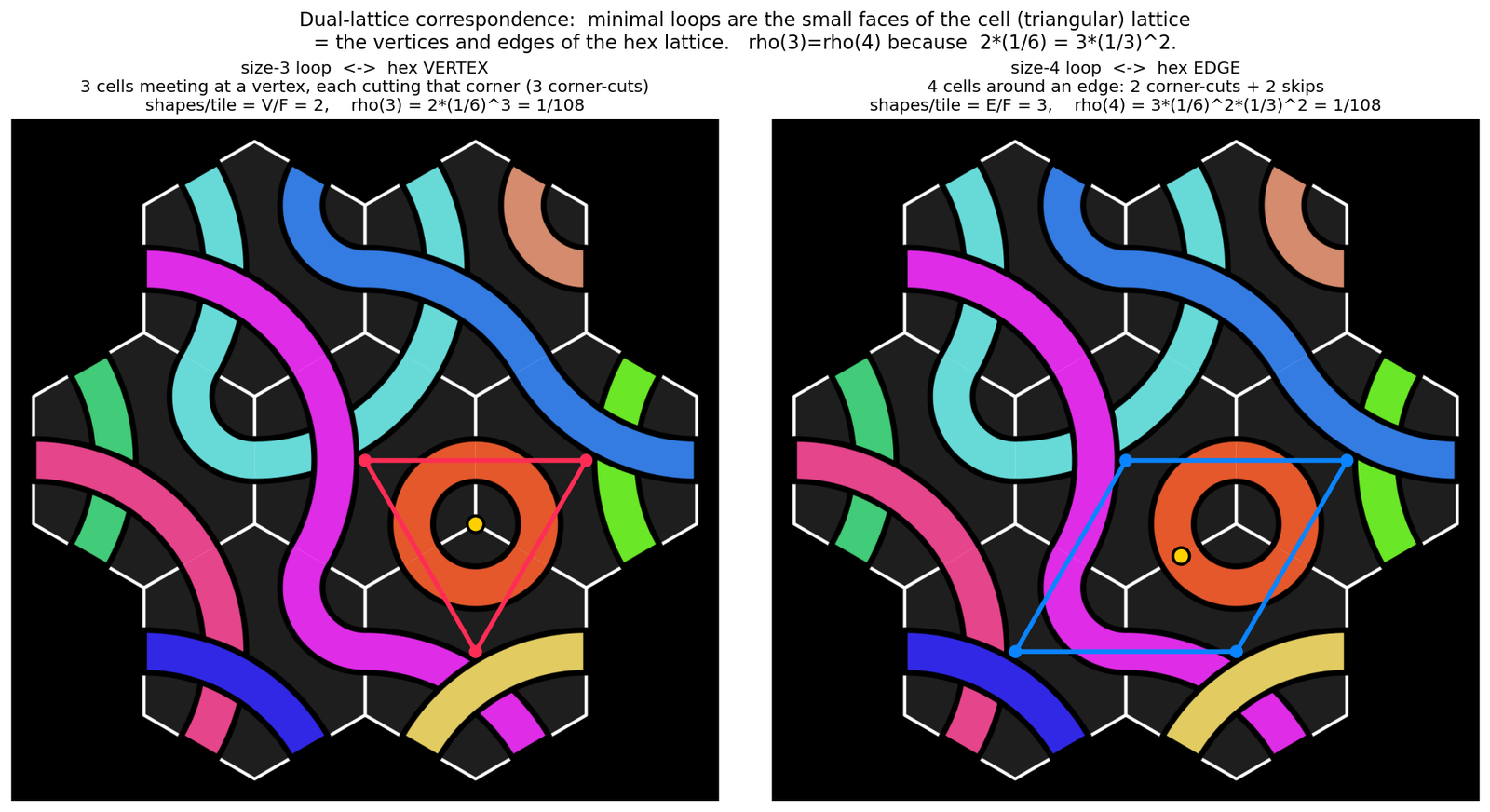
The hex lattice satisfies the incidence ratio V : E : F = 2 : 3 : 1 (Euler characteristic for the torus). Size-3 loops (triangles) are centred at hex vertices; size-4 loops (rhombi) are centred at hex edges. So:
where pcorner = 1/6 (probability of a corner-cut arc at a given tile) and pskip = 2/6 = 1/3 (two rotations give a skip). The equality reduces to
forced by pskip = 2 · pcorner together with V:E = 2:3.
The compensation is exact: the triangle has fewer shapes but tighter arcs; the rhombus has
more shapes but looser (skip) arcs. The product is the same.
What kind of random curves are these?
Measured on 149 738 bulk loops from patches of radius 120–600 (largest single loop: 56 891 arcs).
from s ~ RgDf
ρ(s) ~ s−τ
a new universality class?
The fractal dimension Df = 1.87 ± 0.02 sits between the two known landmarks: the percolation hull / SLE₆ value 7/4 = 1.75 and the dense / SLE₈ value 2. These loops are not in the percolation universality class.
The mechanism: tracing a single strand gives mean-square displacement ∝ lag0.96, i.e. diffusion exponent ≈ 1 — plain Brownian motion. Because strands may cross (over/under at every tile), this is a crossing loop gas — a Lorentz-lattice-gas-like ensemble of mutually crossing random walks, not a self-avoiding O(n) model. The loops are closed orbits of these walks; their Df < 2 even though the walks themselves are space-filling. Best guess: a dense crossing-loop ensemble (κ ≈ 7). The exact universality class is left open.
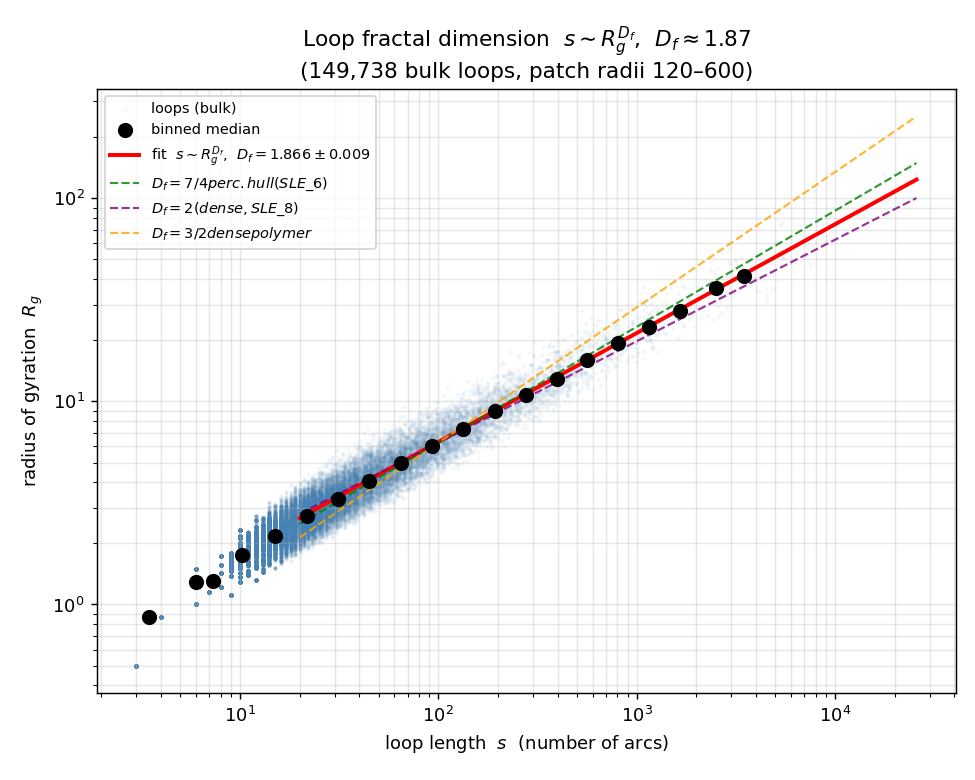
The scaling relation τ = 1 + 2/Df is satisfied to ~1%, tying the
loop-size power law to the fractal geometry. Both sides are consistent with Df ≈ 1.87:
the number density of loops of size s falls as s−2.07 (from geometry) and as
s−2.08 (from spectrum), a strong self-consistency check.
The complete quantitative picture
What remains open: the exact value of c (the sum over all loop sizes is not closed-form beyond the first two), and the precise SLE universality class (κ ≈ 7 is a guess, not a proof). The knot structure of individual loops — which turns out to be rich — is covered on the Knots page.