Interactive Explainer

Six sides. Three paths.
Every tile connects.

Place hexagonal tiles at random and watch closed loops emerge from pure combinatorics — one loop per 28 tiles, forever.

0
tiles
0
open paths
0
loops
Speed

Random tiles. Emergent structure.

Each hex tile carries three non-crossing paths connecting opposite-or-adjacent sides. Rotate it randomly and place it in a growing spiral. The paths glue across shared edges to form a single union-find over lattice edges. Loops close exactly when a new connection joins two edges already linked — the same moment two random walkers meet on the perimeter. The results are richer than they look.

1/216

First possible loop

The third tile completes the central triangle with probability (1/6)³ — the first opportunity in the spiral.

1/28

Loop rate

One loop closes for every ~28 tiles placed, converging to c = 0.03568 loops per tile in the large-N limit.

3₁

Smallest knot

Fixed over/under crossings promote every closed loop to a real knot diagram — smallest is a trefoil in 9 arcs.

Watch the key results emerge

A 200-tile spiral runs below. The loop density counter ticks up every ~28 tiles, converging toward the universal constant c ≈ 0.0357. The fractal dimension and smallest knot are hard constants — discovered by simulation at scale.

Tiles placed
0
spiral placement order
Loops closed
0
density → c ≈ 0.0357
≈ 1 loop / 28 tiles
Open paths
0
grows as 2√3 · √N
boundary effect (= B/2)
Loop density
converges to 0.03568 ± 0.00008
Fractal dimension
≈ 1.87
loops: 1.87 ± 0.02
between SLE₆ (1.75) and SLE₈ (2)
Smallest knot
3₁
trefoil in 9 arcs / 6 tiles
P(unknot) ~ e−s/177
live spiral
Progress 0 / 200
Speed
Loop events

Loops ignite as the spiral grows

In a 900-tile patch, 30 loops bloom out of the tiling — twenty of them tiny (size 3–7), plus one winding 81-arc giant. The video shows the spiral forming tile by tile; each loop flashes white at the moment it closes.
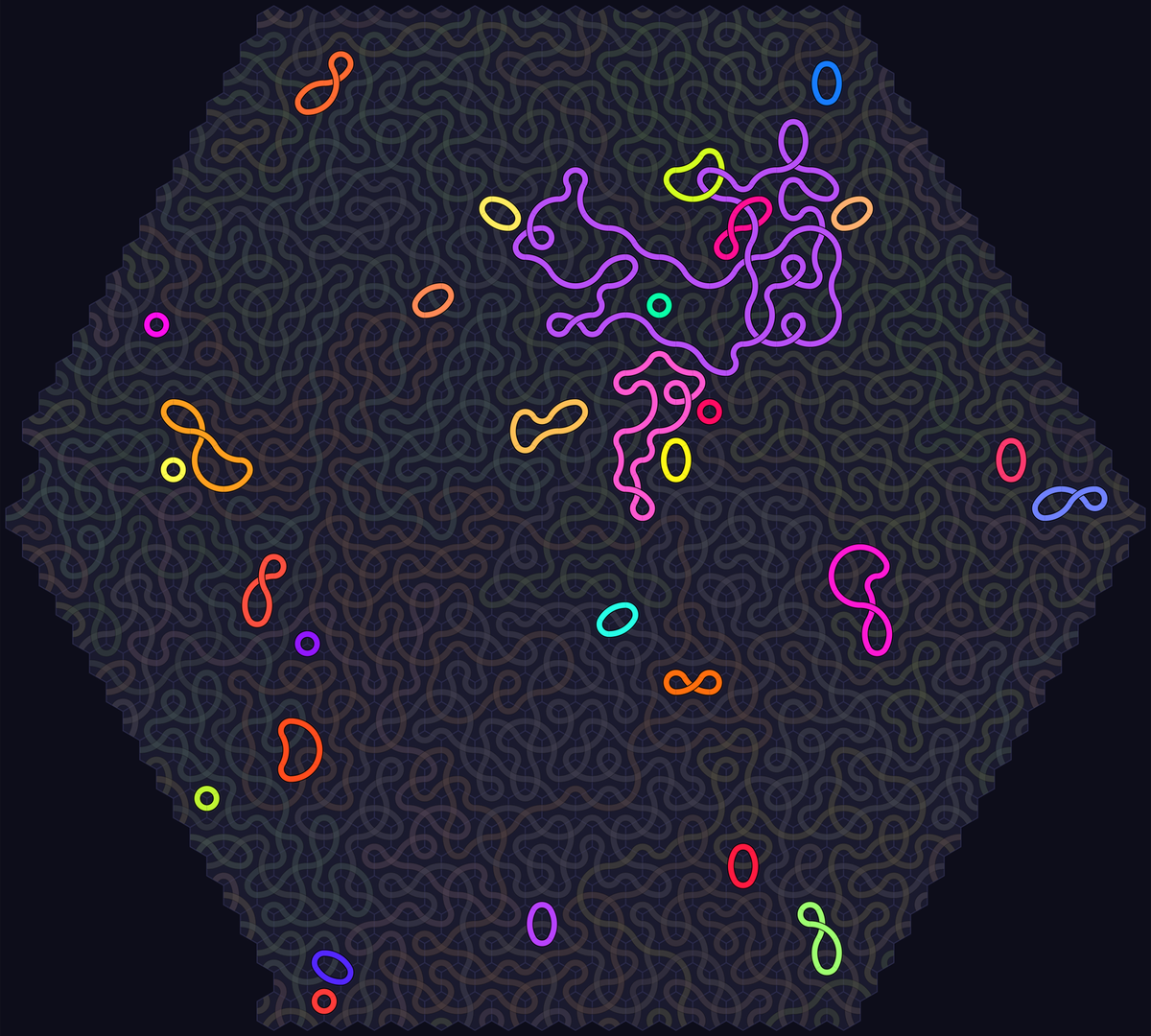
900-tile spiral with 30 loops highlighted in vivid colours against muted open paths
Same 900-tile patch: closed loops lit, open paths muted. Most loops are tiny specks; one magenta giant dominates.
547-tile spiral growing tile by tile — 16 loops bloom. Finite-size suppression gives c ≈ 0.029 here vs. the bulk 0.0357.
Key identity: every open path has two ends on the boundary, so paths = B/2 exactly — boundary geometry fully determines the path count. Loops are the genuinely random quantity.
A surprising zoo of results

Beyond the loop density and fractal dimension, the model hides knot theory, two-player game theory, and a novel growth process — all from one simple rule.

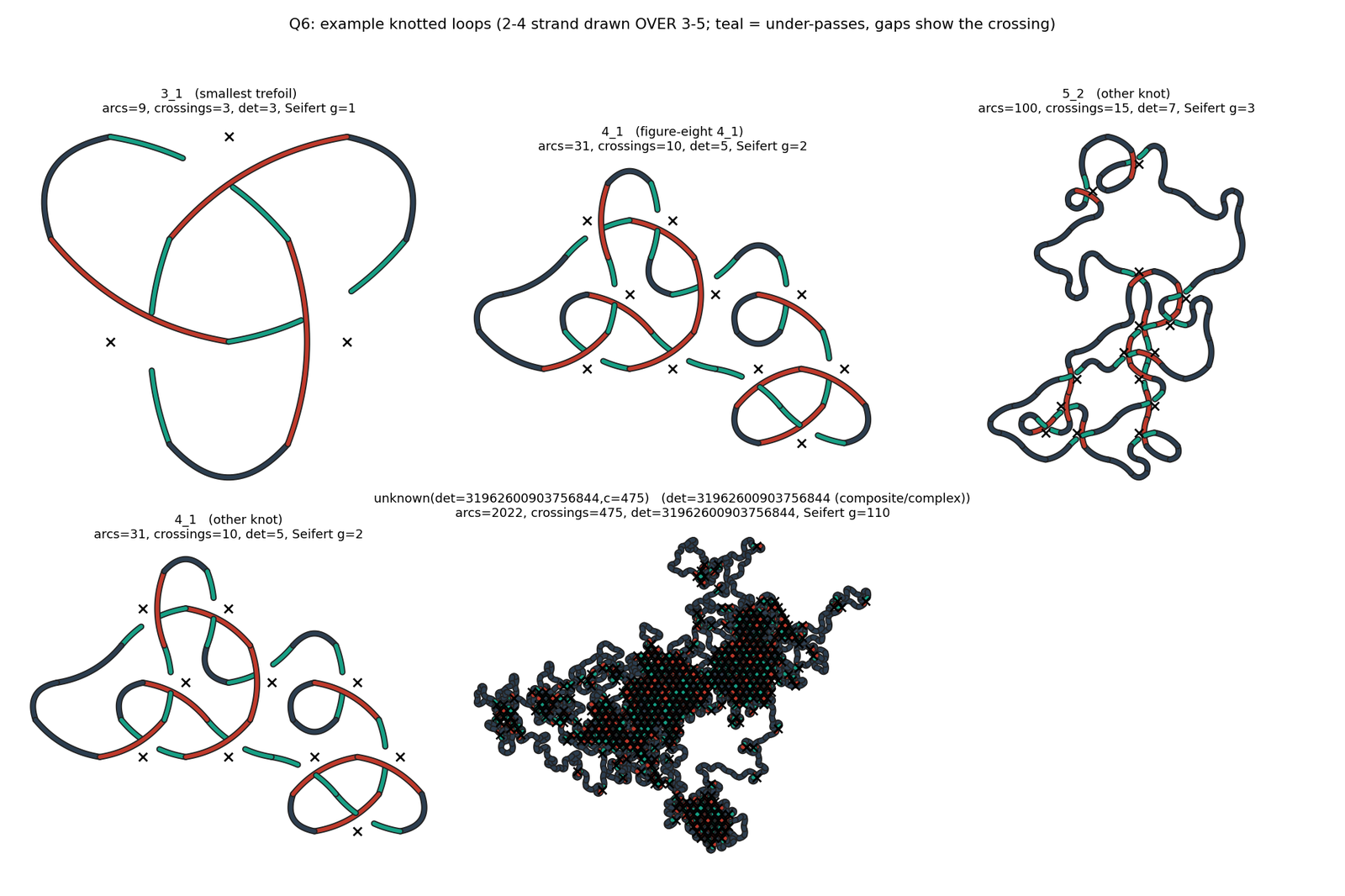
Knot examples: trefoil and other knot types found in loops
Knots in loops
Fixed crossings make every loop a real knot diagram. Trefoil in 9 arcs; 2.5% of loops knotted.
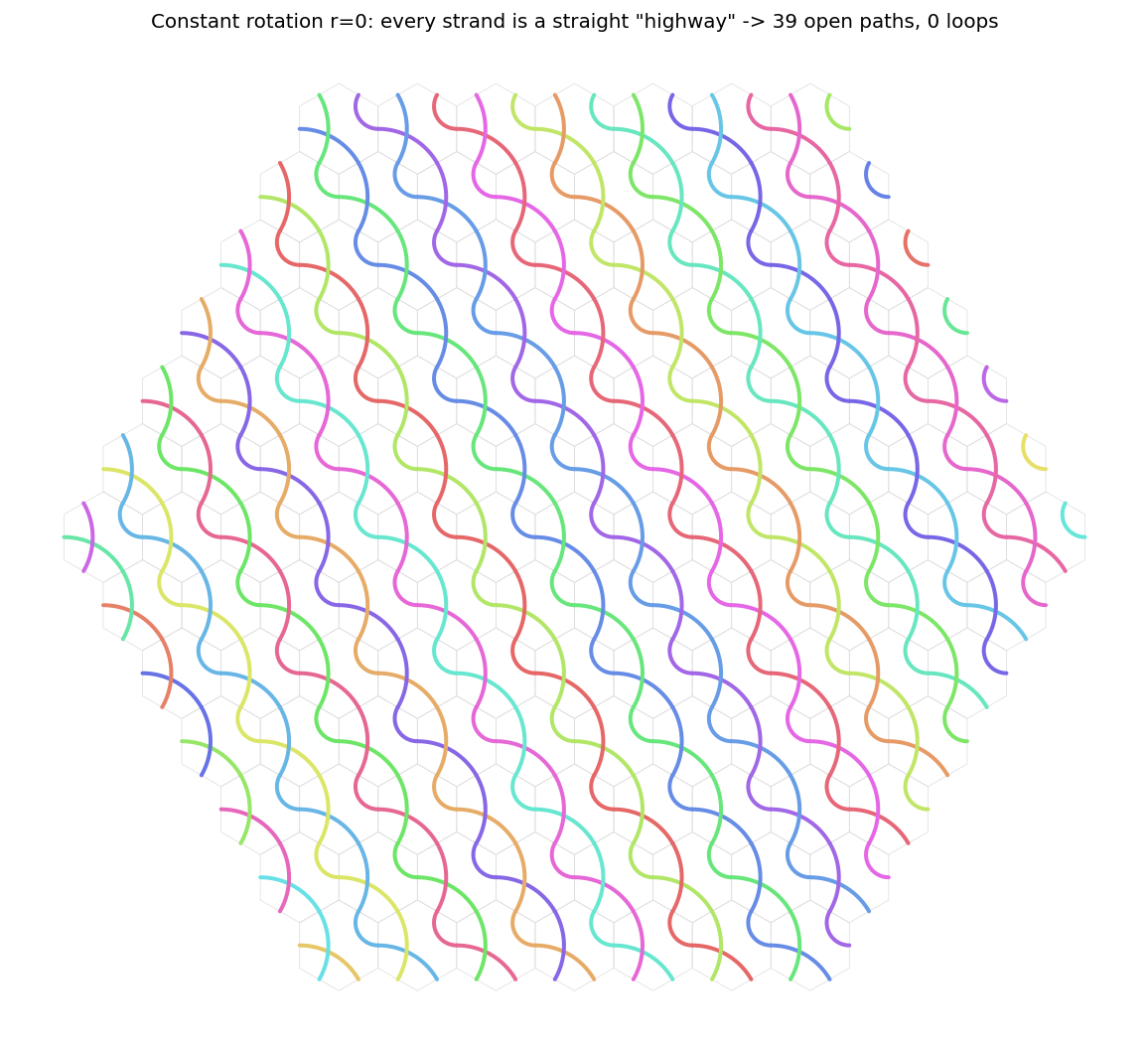
Highway strands — same rotation every tile, zero loops
Loop-free highways
Give every tile the same rotation — strands become bi-infinite highways, zero loops at any scale.
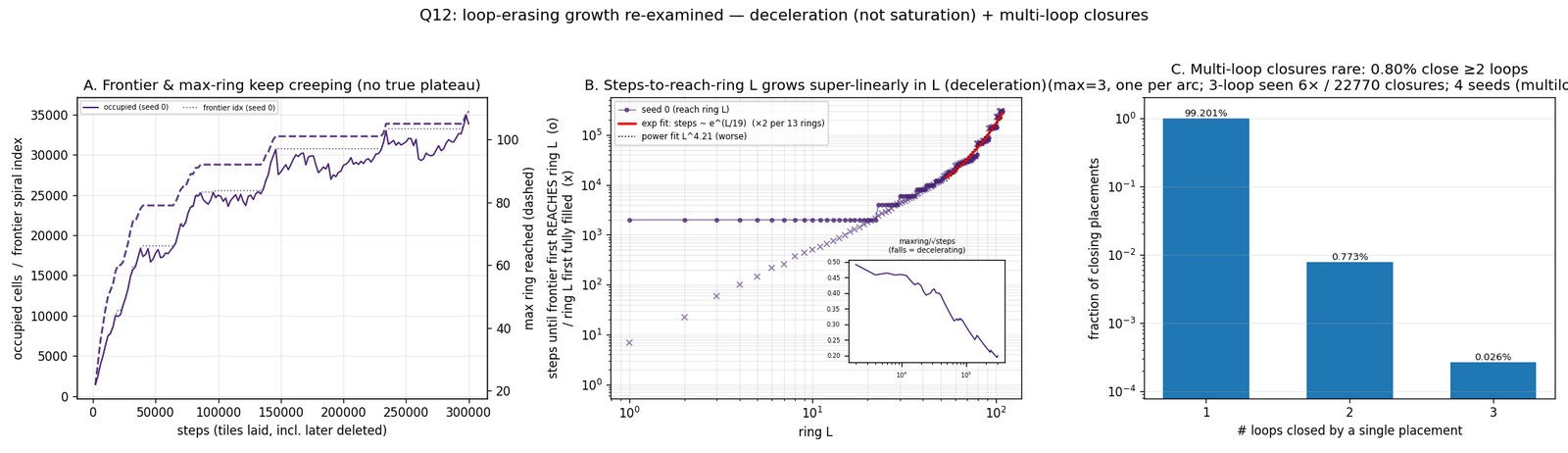
Loop-erasing growth process — compact eroded disk
Loop-erasing process
Delete tiles when a loop closes — avalanches follow a power law P(s) ~ s−1.97.

Six chapters, one model

Each page dives into a different facet — interactive widgets throughout.